Strait of Hormuz Risk Premium: Uncertainty as an Asset
Class
By the Curmudgeon with Victor
Sperandeo
Geopolitical Overview:
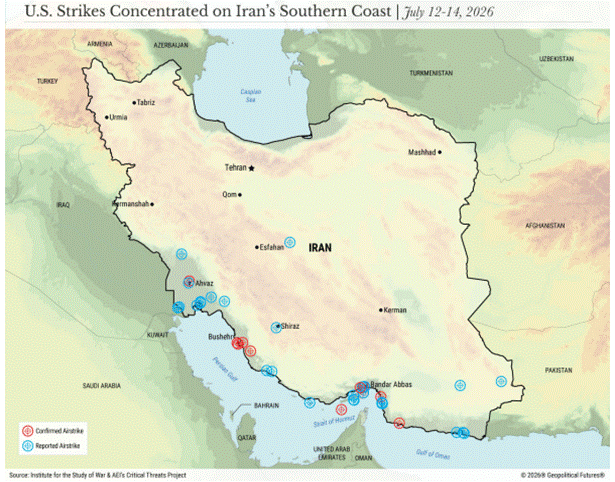
Earlier this week, U.S. forces executed over 300 strikes on Iranian military
assets (see map below)—degrading naval, aerospace, and logistical
infrastructure—and enforced a naval blockade restricting traffic to/from
Iranian sea ports. Iran has responded by launching drones and missiles at U.S.
regional bases and its allies in Jordan and Kuwait.
Despite Iranian retaliation, Tehran has avoided escalating
the conflict to major energy infrastructure, mitigating broader supply shocks. Iran has also released a U.S. citizen
-Dena Karari- who had been detained via an exit ban
for 566 days. That might be perceived as an “olive-branch” gesture from the
Islamic Republic.
U.S. reinstatement of a strict naval blockade enforces
restricted port access for Iran, while formal transit avenues for neutral
commercial shipping remain open. Yet
degrading Iranian military capabilities does not equate to compelling Tehran to
accept U.S. terms to end the conflict. While Washington can suppress Iran’s
capacity for direct maritime disruption, guaranteeing commercial stability
without a prolonged campaign remains unfeasible. Consequently, Iran's ability to
sustain systemic uncertainty limits U.S. leverage and prevents a decisive
political victory.
Sustained conflict in the Persian Gulf threatens roughly 20%
of global oil transit, creating supply chain bottlenecks that drive up shipping
and insurance premiums. Disrupted trade flows inflate energy and commodity
costs worldwide, forcing major shipping conglomerates to route vessels around
the Cape of Good Hope, which severely strains global vessel capacity.
Rather than capitulating to
Washington, Tehran can leverage the macroeconomic fallout of these supply
constraints. By enduring a prolonged campaign, Iran retains enough
asymmetric leverage to deny the U.S. a clean political or economic
resolution.
Image
Credit: Geopolitical Futures
………………………………………………………………………………………………
U.S. Energy Secretary Chris Wright stated in a Sunday
interview that the United States is dedicated to assuring the flow of commercial
traffic through the Strait of Hormuz, though diplomatic off-ramps remain an
option if Iran is willing to negotiate.
…………………………………………………………………………………………..
Victor on the U.S. - Iran War:
Some prominent oil analysts say the
U.S. attack on Iran is one of the greatest blunders of all time. Certainly, it
is the worst political calculation since Vietnam. It will cost the Republican
party power and much more … a loss of TRUST!
In my opinion, this war cannot be won
without U.S. boots on the ground. The number of U.S. troops the Generals say
will be needed for armed combat will surely be under-estimated. Based on my
research of past wars, 50% of the U.S. armed forces would die trying to take
the Strait, as there is no place to hide once they reach the beach. That is why
the U.S. military has not dared try a land invasion….as some naïve observers
say, "to finish the job.”
-->Do not forget that Election
Day is only 106 days from Monday July 20th. I expect the GOP to
lose seats due to this war, especially in the House of Representatives where
they can afford to lose only two seats to retain their majority.
-->Please see my observations and
thoughts on the Energy Markets, Conclusions, and Addendum below.
..................................................................................................
Economic and
Market Impact:
The resumption of the U.S.–Iran confrontation (post MOU) is
more than a war. It is also a pricing mechanism for global risk assets. If Iran expands targeting to Saudi, Emirati,
or Qatari infrastructure—whether via proxies, missiles, or cyber-physical
attacks—the risk premium shifts from commodity pricing into sovereign and
credit markets.
Sovereign wealth flows, which have been a stabilizing force
in global equities and private markets, could become more cautious, more
regional, or temporarily impaired.
Despite extensive U.S. strikes degrading Iranian
capabilities, markets are not responding to the battlefield. They are responding to uncertainty. It’s
uncertainty, not destruction, that drives capital flows, insurance premiums,
and commodity pricing.
The Strait of Hormuz
remains functional—but not a reliable conduit for shipping. That distinction
matters. Oil does not need to stop flowing to move prices higher. It only needs
to be perceived as intermittently vulnerable. A single successful disruption
can reset risk models across energy, shipping, and insurance markets.
As a result, even low-frequency attacks can sustain a
structural premium in crude and
(especially) refined product pricing.
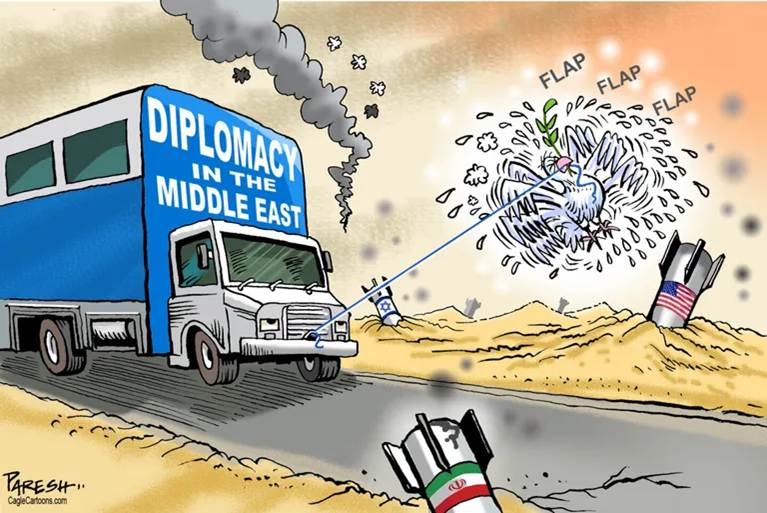
This creates a classic conundrum: The U.S. must conduct continuous
air strikes to suppress volatility while Iran only needs episodic retaliation to reintroduce
it.
Image
Credit: Paresh Nath / Copyright 2026 Cagle Cartoons, Inc.
Oil Market
Indicators Are Already
Flashing Red:
The transmission channels are visible in real time:
·
Brent crude oil structure
has flipped from contango to backwardation, with the near month contract
trading at an $8–9 premium to six-month-out futures—the largest spread since
early June. This signals tight near-term physical availability and elevated
geopolitical risk pricing.
·
WTI crude oil trades around $81.77/barrel following recent tanker strikes
and regional friction. Consensus
baseline forecast averages $80–$87/barrel for late 2026.
·
Asymmetric risk: If Tehran
successfully enforces a prolonged blockade or severely degrades Strait of Hormuz transit, institutional modeling targets a
sharp WTI surge above $100–$111/barrel.
·
War-risk insurance premiums
for Gulf transits have surged from a baseline of 0.1–0.25% of vessel value to
1–7.5%, with the most exposed routes seeing rates as high as 3–7.5% of hull
value. For a $250 million VLCC, that translates into insurance costs jumping
from roughly $600,000 to $7–9 million per voyage.
·
Tanker freight rates have
responded accordingly, with super max rates to Asia
approaching two-month highs and daily hire rates increasing by $2,000+ in
response to perceived risk.
·
Middle East crude benchmarks
(Oman, Dubai, Murban) have swung from discounts to
premiums, confirming that supply concerns are being priced regionally, not just
in benchmark Brent.
Victor on the Energy Markets:
The
critical issue of the Iran war that most analyst miss is the misplaced focus
on WTI crude oil futures rather than Brent spot oil, heating oil and diesel
fuel.
The U.S. government manipulates WTI
Crude Oil futures but not Heating oil.
The U.S. still has crude in its “Strategic Petroleum Reserve
(SPR)," so selling futures has no risk for the U.S. government which
has oil it can deliver.
Note the difference in Heating oil
vs. Crude Oil Futures prices:
·
August
Heating Oil Futures made a NEW HIGH on July 13th at $401.43 from the earlier
high of $390.97 on May 19th $406.46).
It's currently at $397.35.
·
August
Crude Oil Futures made a high on May 18th at $99.47, yet it's
currently only $82.49!
Diesel fuel used in trucks and jet fuel used
in airlines are derived from crude oil.
It takes 3 barrels of crude oil to make 1 barrel of diesel fuel! Yet the U.S. has no stockpile of diesel fuel.
Also, it takes a certain type of oil - "sour crude” that is specialized
and complex to refine into diesel fuel.
The “crack spread," traded on the NYMEX, is the
difference between the price of crude oil and the petroleum products extracted
from it, serving as a proxy for an oil refiner's gross profit margin. It gets
its name from the "cracking" process in which crude oil is broken
down into refined products like gasoline and diesel. While the oil price has fallen, gasoline and
diesel prices remain high.
As of July 2026, the benchmark NYMEX
WTI 3-2-1 crack spread has soared to an unprecedented record high of $69.66 per
barrel. This represents an astronomical rise from the 27% baseline seen
at the start of the year, with refining margins now commanding 70% to 75% of
the total value of a barrel of crude.
Rather than signaling a traditional
consumer-led recession, this extreme "split decision" in the energy
markets—where crude oil prices are modestly rising or stabilizing while
consumer fuel prices remain stubbornly high—presents acute warning signs for
the global economy. See Conclusions
below for the details.
...................................................................................................
Trigger-to-Impact Matrix: What Moves
Markets
|
Trigger Event |
Expected Brent Move |
Insurance Rate Impact |
Tanker Hire Impact |
|
No additional incidents (status quo) |
Flat to –$3 (premium compression) |
Gradual normalization to 1–3% |
Modest easing; freight rates drift lower |
|
One additional vessel hit (non-critical) |
+$5–8 |
Jump to 5–7.5% on exposed routes |
+$2,000–4,000/day on key lanes |
|
Multiple vessels hit in 30-day window |
+$10–15 |
Rates toward 7.5–10% |
Hire rates spike $5,000+/day due to
scarcity |
|
Attack on Gulf energy infrastructure
(terminal, refinery, storage) |
+$15–25+ |
10%+ on high-risk routes; capacity
constraints |
Severe tightening; rerouting premiums |
|
Expansion to Bab el-Mandeb or Red Sea
chokepoints |
+$10–20 (global rerating) |
Broad-based increase across Middle
East/Red Sea |
Global freight repricing; extended voyage
times |
|
Negotiated pause / measurable
de-escalation |
–$8–12 (sharp unwind) |
Rapid compression toward 0.5–1% |
Normalization; backwardation flattens |
Credit: Table generated by
Perplexity.ai
..........................................................................................................
Upside Energy Infrastructure Risks:
The real risk emerges if the U.S. conflict with Iran degrades into sustained infrastructure targeting or maritime
insecurity. At that point, the correlation structure shifts:
energy strength begins to signal economic stress rather than growth, credit
spreads widen, and global cyclicals reprice lower.
Any credible threat to Gulf energy infrastructure or
expansion to Bab el-Mandeb would trigger a nonlinear repricing: Brent could
spike $15–25 higher, insurance rates could approach 10% of hull value on the
most exposed routes, and global volatility indices would react sharply.
Downside Scenario:
A negotiated pause or measurable reduction in attack
frequency would quickly deflate premiums. Energy markets are highly sensitive
to stabilization signals, and positioning is light enough that a swift mean
reversion is plausible.
The Bottom
Line for Capital Flows:
·
This is not a binary
“win/lose” dynamic. It is a contest over exhaustion rates, expressed through
markets.
·
Iran aims to keep volatility
alive long enough to extract concessions.
·
The U.S. aims to compress
volatility before the cost of doing so outweighs the benefit.
Conclusions:
For investors, the key is not who is “winning” militarily,
but whether risk is expanding or declining at the margin.
The most likely near-term outcome is neither resolution nor
normalization of the Iran conflict, but managed instability. A
partial reduction in disruptions sufficient to ease acute pricing pressure,
without eliminating the embedded risk premium.
Victor: the existential world problem of the
Iran War is twofold:
1. Businesses use diesel fuel which is
in short supply.
2. The storage of U.S. crude oil
reserves is running out.
Also, the bottom of the barrel of
U.S. oil reserves is ~15% of the total held in storage. It cannot be used to make refined products,
as the oil at the bottom of the storage is sludge.
This portends Armageddon for
food, fertilizer, helium and many more refined energy products that have to be delivered throughout the world. There is no
substitute for those products which are essential for trucks, ships,
and planes. Also note that the U.S. military has a priority claim on energy
supplies.
The Fed can raise interest rates to
10%+ yet that would mean nothing for oil, diesel and gasoline prices, as the
price of energy will be bid up by businesses as long as
transit through the Strait is constrained.
What history shows is that the Fed
can do whatever it wishes and find the applicable numbers to justify it. This
allows appointed political bureaucrat bankers (FOMC members) to rule the U.S.
economy and its citizens, not their Constitutionally elected representatives.
Curmudgeon:
·
Energy markets will continue
to trade with a geopolitical uncertainty
risk premium.
·
Shipping will remain frictional, with elevated insurance and freight costs.
·
Volatility will stay
structurally elevated, with episodic spikes on escalation headlines.
Markets are not waiting for a U.S.-Iran winner. They are
pricing in the persistence of risk.
..........................................................................................
End
Quote:
An age-old recurring problem, but this one is unique:
“The cycles of shortage and surplus characterize the entire
history of oil.” Daniel Yergen, Global Energy expert.
.........................................................................................
Addendum - Victor on the Markets:
·
Gold is making a low. It certainly can go
to $3,800/ounce, or even $3500, but that would be unlikely.
·
I
suggest buying a small 5-10% Gold position here with the intent of going to
20-25% later.
·
Stocks
are topping, but no shorting, as Trump is the guardian angel of the stock
markets for his political propaganda.
·
U.S.
Treasury Bonds and Notes have made their lows.
·
No
increase in the Fed Funds rates is currently in the cards.
·
Commodities
X-Oil are in a downtrend. Example: After Kroger’s and Walmart cut food and meat
prices, August Live CATTLE futures dropped 10% in a straight line decline over
20 days.
..........................................................................................
Wishing you good health, success and
good luck. Till next time.....................
The Curmudgeon
ajwdct@gmail.com
Follow the Curmudgeon on Twitter @ajwdct247
Curmudgeon is a retired investment professional. He has been involved in financial markets since 1968 (yes, he cut his teeth on the 1968-1974 bear market), became an SEC Registered Investment Advisor in 1995, and received the Chartered Financial Analyst designation from AIMR (now CFA Institute) in 1996. He managed hedged equity and alternative (non-correlated) investment accounts for clients from 1992-2005.
Victor Sperandeo is a historian, economist and financial innovator who has re-invented himself and the companies he's owned (since 1971) to profit in the ever-changing and arcane world of markets, economies, and government policies. Victor started his Wall Street career in 1966 and began trading for a living in 1968. As President and CEO of Alpha Financial Technologies LLC, Sperandeo oversees the firm's research and development platform, which is used to create innovative solutions for different futures markets, risk parameters and other factors.
Copyright © 2026 by the Curmudgeon and Marc Sexton. All rights reserved.
Readers are PROHIBITED from duplicating, copying, or reproducing article(s) written by The Curmudgeon and Victor Sperandeo without providing the URL of the original posted article(s).