Foreign Central
Banks Sell Treasuries as U.S. Dollar Continues to Rise
By the Curmudgeon with Victor
Sperandeo
Foreign Banks Dump U.S. Treasuries:
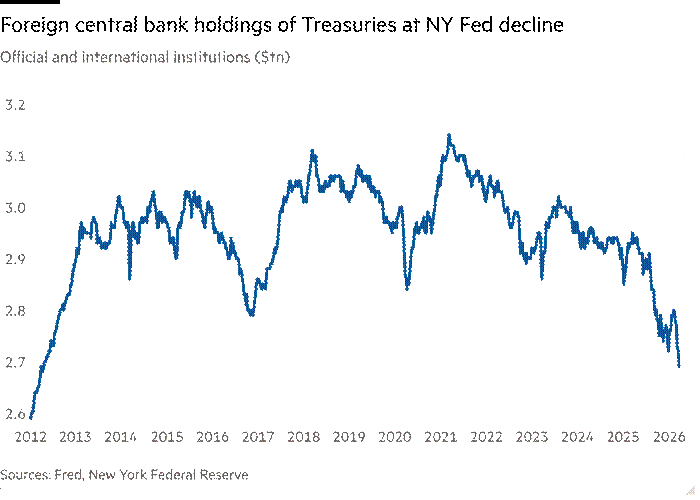
The Financial Times reports that foreign central banks
have reduced their U.S. Treasury holdings to the lowest level since 2012,
reflecting reserve diversification, foreign exchange (FX) intervention, and
balance-of-payments pressures tied to higher energy prices.
“The foreign official sector is selling Treasuries,”
said Meghan Swiber, a U.S. rates
strategist at Bank of America.
Official custodial holdings at the New York Fed fell by $82
billion since February 25th to $2.7 trillion, according to Fed data,
as the Iran war and the closure of the Strait of Hormuz lifted oil prices and
strengthened the dollar. Other sources
say that foreign central banks have sold over $90 billion in US Treasuries over
a five-week period ending around April 1, 2026.
The move comes as surging energy costs pressure oil-importing
economies. Elevated energy prices have strained the balance sheets of
oil-importing economies, compelling many to liquidate U.S. government
securities to stabilize domestic currencies and meet external funding needs.
Concurrently, several monetary authorities have intervened in foreign exchange
markets to support their local currencies — actions that typically require
selling U.S. dollar reserves, further contributing to the decline in Treasury custodial
holdings.
Brad Setser, a senior fellow at the Council on Foreign Relations, who
studies foreign holdings of Treasuries, said oil importers such as Turkey,
India and Thailand are probably among those selling Treasuries as they pay
higher prices for oil, which is denominated in dollars.
Analysts also noted that some Treasury holdings might have
been moved to other custodians besides the New York Fed, rather than having
been sold outright. But the sales recorded in the Fed data were still notable,
particularly since the Treasury market had roughly tripled in size since 2012,
when the Fed last recorded this level of selling, Swiber said.
Foreign official holdings of Treasuries held at the Fed have
declined in recent years, as managers of foreign currency reserves have
diversified away from dollars. That has made foreign private investors an
increasingly important part of the market.
………………………………………………………………………………………………..
U.S. Dollar Strength Continues:
Meanwhile, the U.S.
dollar has been rising due to higher energy prices, safe-haven demand, and
the fact that FX intervention often involves selling local currency against
dollars rather than selling dollars themselves.
The DXY is up 2.44% from February 27th (1 day before
the Iran war started) to April 3rd (97.65 to 100.03).
Higher oil prices (which are denominated in U.S. dollars)
tend to widen the import bill for energy-dependent economies, which can
pressure their trade balances and currencies. That often requires them to
exchange their local currencies into dollars to pay for imported oil.
Also, investors flee to the U.S. dollar, perceiving it as a
“safe haven” when markets are pricing geopolitical risk and inflation into
their forecasts.
Therefore, a decline in foreign holdings of Treasuries can
coexist with a stronger U.S. dollar when the dominant market force is risk
aversion plus energy-driven inflation pressures.
According to Hedgeye, the U.S. dollar carries a -0.84
inverse intermediate TREND correlation to SPX and a +0.94 positive correlation
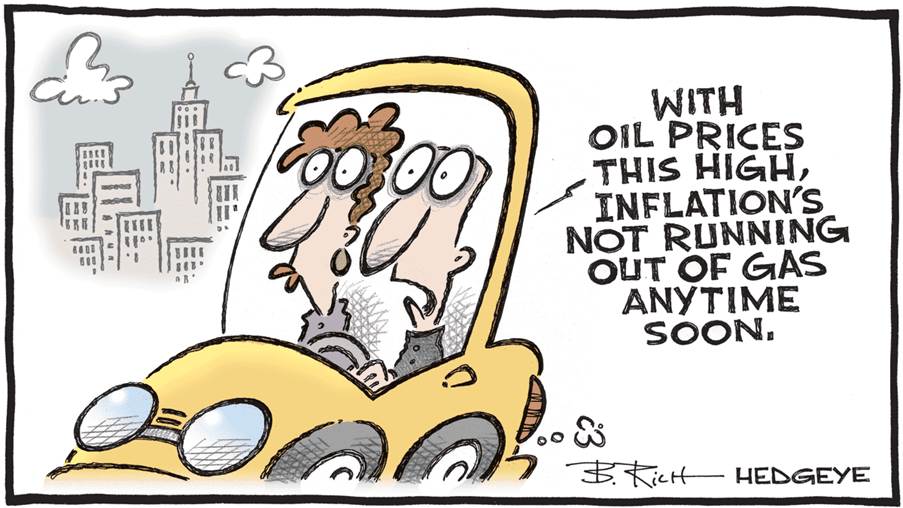
to Brent Oil. Their CPI Nowcast has re-accelerated above 4% by Q4-2026,
implying U.S. interest rates will stay "higher for longer."
….………………………………………………………………………………………………………………….
Victor’s Comments:
The U.S.–Iran war has upended global hedging and reserve
management dynamics across major oil-exporting nations bordering the Persian
Gulf. Typically, producers in Gulf nations (Bahrain, Iraq, Kuwait, Oman, Qatar, Saudi Arabia, and the United Arab Emirates)
hedge their oil price exposure by shorting crude futures against forward
physical sales until delivery. Once the
physical oil is delivered, they receive payment in U.S. dollars, cover their
short oil futures positions, and recycle the proceeds into reserve
assets—mostly U.S. Treasuries or gold.
Now, with shipments through the Strait of Hormuz disrupted,
those same producers are unable to complete delivery, forcing them to raise
liquidity by liquidating reserves. The immediate source of funds is
short-term U.S. paper—T-bills—followed by sales across the Treasury curve from
2-year to 30-year maturities.
As liquidity pressures deepen, selling expands to U.S.
large-cap equities, particularly the Dow 30 and the MAGNIFICENT 7 stocks that
dominate global portfolios. Precious metals are also being liquidated, with
gold, copper, platinum, and palladium all showing synchronized technical
breakdowns that mirror each other. This suggests that “gold being sold for
margin calls” is a pretext; the real driver is systemic liquidity stress.
European markets add further strain. Most EU economies remain
structurally weak following the loss of Russian energy imports. France is an exception because it has nuclear
energy which is the leading source of electricity in the country, but it
suffers from macro imbalances like excessive government spending and debt.
The Eurozone, already under dollar shortage stress, must now
compete with Japan and South and East Asian nations for dollar funding to
purchase emergency oil supplies. That underscores the strategic vulnerability
created by overreliance on renewable energy sources (solar and wind), which can
be used at the margin for energy needs, but is very undependable.
-->The lesson learned here is that nations must be
self-sufficient in their basic food and energy needs. They also must hold
reserves in different energy resources as well as
dollars.
Victor’s Conclusions:
Dislocations between futures and physical oil prices have
widened significantly—spot barrels of oil are trading at significant premiums
to futures contracts for WTI crude.
Market participants increasingly suspect official
intervention, with the U.S. likely selling crude oil futures to keep the price
down and prevent runaway inflation expectations. While unconfirmed by Treasury
officials, price action strongly implies coordinated futures market activity
designed to contain the geopolitical and inflationary fallout.
End Quote:
Countries must resist the urge to hoard oil and fuel during
the energy crisis triggered by the US-Israeli war on Iran, the head of the International
Energy Agency has warned, with supplies expected to dwindle further if the
Strait of Hormuz remains closed.
“I urge all countries not to impose bans or restrictions on
exports,” Fatih Birol told the FT. “It is the worst time when you look
at the global oil markets. Their trade partners, their allies and their
neighbors will suffer as a result.”
….………………………………………………………………………………………………………………………..
Wishing you success, good health and good luck. Till next time…..
The Curmudgeon
ajwdct@gmail.com
Follow the Curmudgeon on Twitter @ajwdct247
Curmudgeon is a retired investment professional. He has been involved in financial markets since 1968 (yes, he cut his teeth on the 1968-1974 bear market), became an SEC Registered Investment Advisor in 1995, and received the Chartered Financial Analyst designation from AIMR (now CFA Institute) in 1996. He managed hedged equity and alternative (non-correlated) investment accounts for clients from 1992-2005.
Victor Sperandeo is a historian, economist and financial innovator who has re-invented himself and the companies he's owned (since 1971) to profit in the ever-changing and arcane world of markets, economies, and government policies. Victor started his Wall Street career in 1966 and began trading for a living in 1968. As President and CEO of Alpha Financial Technologies LLC, Sperandeo oversees the firm's research and development platform, which is used to create innovative solutions for different futures markets, risk parameters and other factors.
Copyright © 2026 by the Curmudgeon and Marc Sexton. All rights reserved.
Readers are PROHIBITED from duplicating, copying, or reproducing article(s) written by The Curmudgeon and Victor Sperandeo without providing the URL of the original posted article(s).