Impact of Rising
Oil Prices on the Economy and Markets due to Middle East War
By Victor Sperandeo with the
Curmudgeon
Introduction:
Oil is by far the single most
important macroeconomic variable. Global economic stability depends on energy
prices, as oil underpins production, transportation, and the cost of goods.
When supply contracts, inflation pressures surge across all sectors of the
economy. Expectations of future price
increases and/or shortages often prompt inventory hoarding.
On December 31, 2025, front-month WTI
crude oil futures (February) closed at $57.41. By March 6, 2026, the May
contract settled at $87.52, up 52.5% year-to-date. The closure of the Strait of
Hormuz has sent gasoline and diesel prices higher for
five consecutive sessions. If the Strait remains blocked for more than 30–to-100
days, large portions of the global economy risk entering recession or even a depression.
Policy responses remain highly
fragmented. The U.S. recently allowed India to purchase Russian crude, and
discussions in Washington include easing Russian sanctions on its oil exports.
Meanwhile, proposals for U.S. naval escorts through the Strait are totally unrealistic:
about 120 tankers transit daily, while the active number of U.S. destroyers
able to operate in the region is around eight. And they’d be sitting ducks for
Iran missile strikes! The Navy has also declined this suggestion. Logistically,
any sustained U.S. protection effort is untenable, which will keep oil prices
high.
Market pricing reflects deep
concern. April WTI crude oil closed at $91.27, while November 2026 futures
settled near $70.00. That’s a 23% backwardation that implies expectations of
short-term scarcity and geopolitical risk premium. If Middle East tensions persist,
crude oil could spike to $125–$150 per barrel within 60 days, driving U.S.
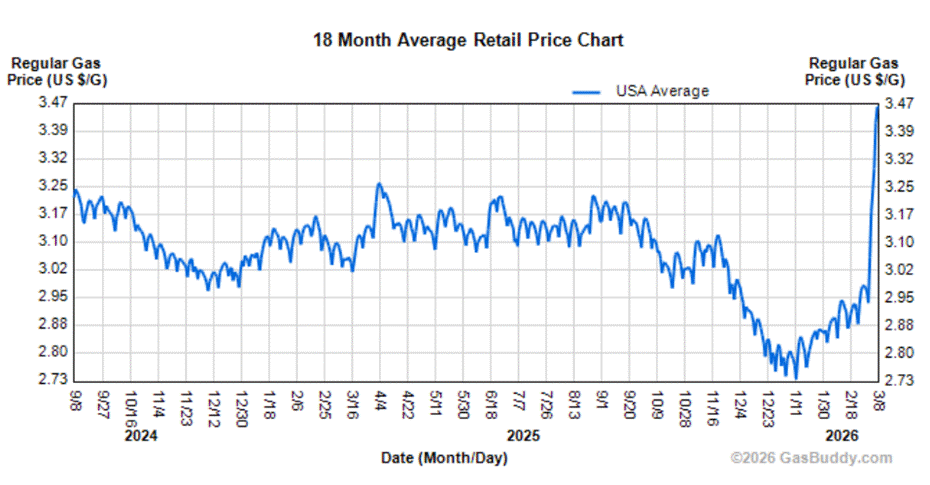
retail gasoline toward $4.75–$5.00 per gallon (regular), which is today’s gas
price in California. This week’s gas
price spike is depicted in this chart:
Analysis of U.S. War with
Iran (Victor):
The current war with Iran has
significantly expanded via Iranian retaliatory strikes in countries that host
U.S. military bases, such as Qatar, UAE, Bahrain, Kuwait, Jordan, Iraq, and
Saudi Arabia. This is now a Middle East war, which is costing the U.S.
government an estimated $1 billion a day, and the defense industry loves it.
However, the war is an illegal
fraud, caused by the megalomania of one man - President Donald Trump. The U.S.
Constitution does not allow wars without “checks and balances” via a vote
by Congress. The U.S. Constitution
explicitly grants Congress the sole power to declare war in Article 1
Section 8.
….…………………………………………………………………………………………………………………..
Sidebar - The War Powers Act of 1973:
The purpose of this act was to
limit the President's ability to initiate or escalate military actions abroad
without congressional approval. The President must notify Congress within 48
hours of committing armed forces to hostilities or into situations where
imminent involvement in hostilities is indicated. Troops must be withdrawn and military hostilities
(e.g. air attacks) must end within 60 days unless Congress declares war, passes
a specific authorization, or extends the deadline. An
additional 30-day period (for a total of 90 days) is permitted for the safe
withdrawal of armed forces if necessary.
Exception: The President may act without prior approval in
the event of "a national emergency created by attack upon the United
States, its territories or possessions, or its armed forces."
-->Clearly, there was NO
NATIONAL EMERGENCY CREATED BY IRAN TO PRECIPITATE THIS WAR!
….…………………………………………………………………………………………………………………..
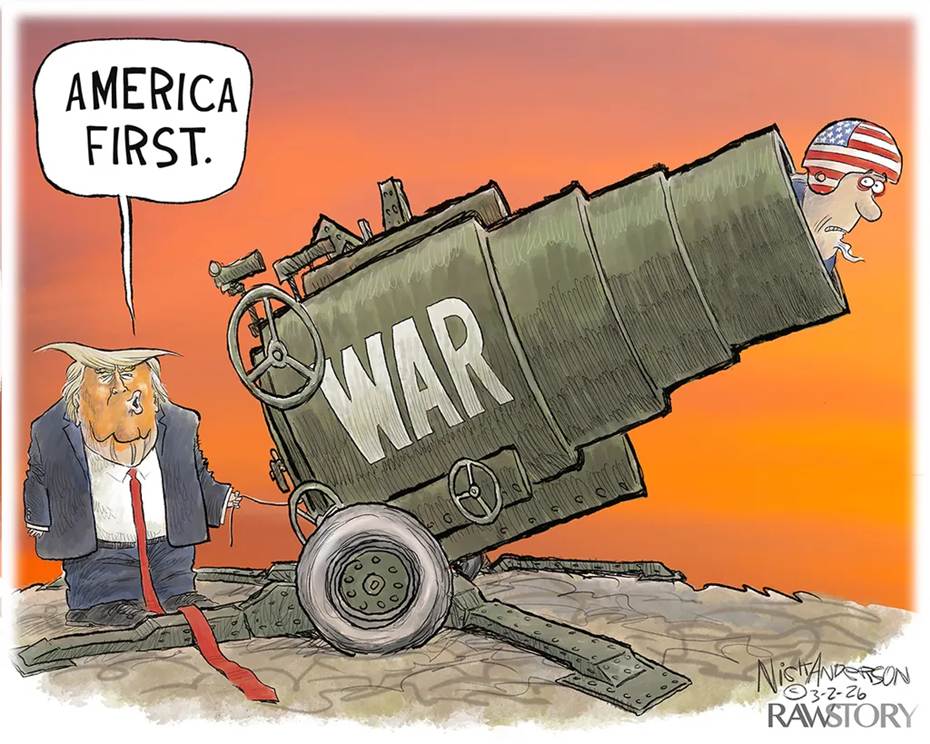
Image Credit: Nick Anderson
/ Copyright 2025 Tribune Content Agency
As such, the legality and
political handling of the U.S. strikes against Iran have eroded policy
credibility, underscoring structural dysfunction in the U.S. constitutional
system governing war powers. Also, the U.S. has no succession plan for the next
leader(s) of Iran which will likely trigger further instability in the region.
Prolonged geopolitical tensions
would likely drive further declines in equities and bonds, while gold,
short-duration U.S. Treasuries, and commodities would attract safe-haven inflows.
Victor’s Conclusions:
The last U.S. war that was
Constitutional was WW II, which was declared by Congress on Japan December 8, 1941,
after the latter attacked Pearl Harbor and December 11, 1941, after Germany and
Italy declared war on the U.S.
Every U.S. war since then was
illegal. Since the current war in the Middle East affects the entire world, it’s
particularly outrageous. Yet few government officials are speaking out? Why
not?
As a student of the law and
history I would conclude the political system the U.S. created is now a
failure. It will cause deep destruction for most citizens, who do not protest
the lawlessness of the U.S. today. Our
so called “representatives” of the House and Senate vote as a group and are loyal
to their Party. They are legally bribed by the Department of War.
End Quote:
“There is no honorable way to
kill, no gentle way to destroy. There is nothing good in war. Except its
ending.” Abraham Lincoln
….……………………………………………………………………………………………………..
Wishing you good health,
success, and good luck. Till next time.
The Curmudgeon
ajwdct@gmail.com
Follow the Curmudgeon on Twitter @ajwdct247
Curmudgeon is a retired investment professional. He has been involved in financial markets since 1968 (yes, he cut his teeth on the 1968-1974 bear market), became an SEC Registered Investment Advisor in 1995, and received the Chartered Financial Analyst designation from AIMR (now CFA Institute) in 1996. He managed hedged equity and alternative (non-correlated) investment accounts for clients from 1992-2005.
Victor Sperandeo is a historian, economist and financial innovator who has re-invented himself and the companies he's owned (since 1971) to profit in the ever-changing and arcane world of markets, economies, and government policies. Victor started his Wall Street career in 1966 and began trading for a living in 1968. As President and CEO of Alpha Financial Technologies LLC, Sperandeo oversees the firm's research and development platform, which is used to create innovative solutions for different futures markets, risk parameters and other factors.
Copyright © 2026 by the Curmudgeon and Marc Sexton. All rights reserved.
Readers are PROHIBITED from duplicating, copying, or reproducing article(s) written by The Curmudgeon and Victor Sperandeo without providing the URL of the original posted article(s).