Trump’s new 15% tariffs
after Supreme Court strike down opens a new era of uncertainty and extended
legal battles
By Victor Sperandeo with the
Curmudgeon
Introduction:
The Supreme Court’s 6–3 ruling striking down President
Trump’s “Liberation Day” tariffs represents a U.S. Constitution
reaffirmation of the complete congressional authority over taxation.
Tariffs are a TAX, and all taxes are within the domain of the
Legislative Branch of government, as stated in ARTICLE 1 of the U.S. Constitution…
the Supreme law of the Land.
The Court’s decision curtails the use of emergency executive
authority as a de facto taxing power; shifts focus back to Congress and opens a
prolonged period of litigation and refund risk tied to tariffs already
collected.
There is now unprecedented policy uncertainty for
global trade, corporate planning, and investments. Also, it presents a huge
problem for the GOP which must defend unpopular tariffs which the nation’s
highest court has nullified.
Hooray! U.S. Constitutional Upheld:
The Supreme Court held that the International Emergency
Economic Powers Act (IEEPA) does not authorize the President to
impose tariffs, emphasizing that tariffs are an exercise of the taxing power
vested in Congress under Article I of the U.S. Constitution. In
doing so, the court majority underscored that statutory language permitting the
president to “regulate… importation” in emergencies cannot be read as a blank
check to levy open-ended duties of “unlimited amount, duration, and scope.”
….………………………………………………………………………………………
Sidebar: The Supremacy Clause
All U.S. laws are governed by “The Supremacy Clause,”
found in Article VI, Clause 2 of the U.S. Constitution. It establishes that the U.S. Constitution,
federal laws made "in pursuance" of it, and treaties are the "Supreme
Law of the Land," overriding any conflicting state laws or
constitutions. It binds state judges to prioritize federal law over state laws.
….……………………………………………………………………………………….
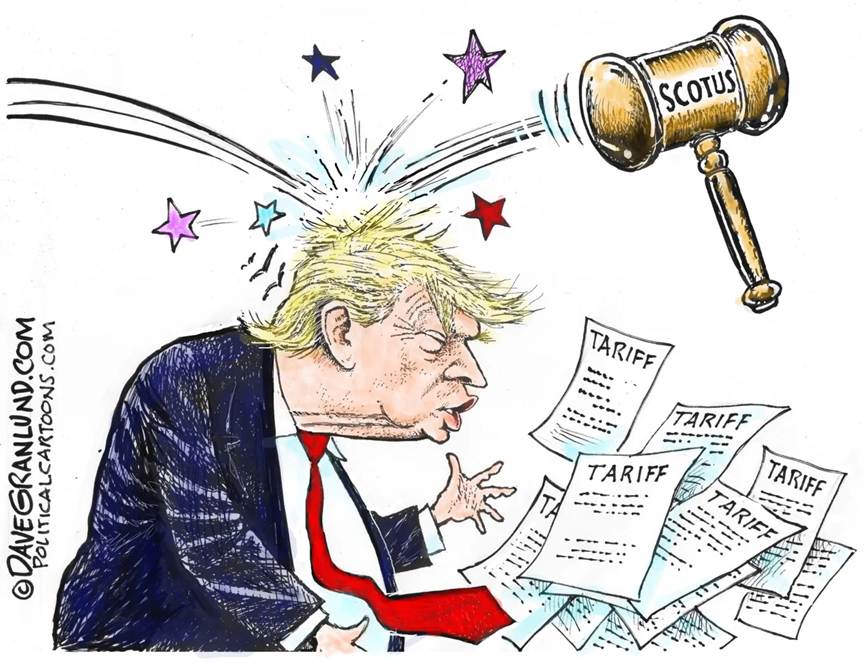
This important Supreme Court ruling effectively
removes IEEPA as a legal foundation for broad, unilateral tariff programs and
reinforces the Supremacy Clause principle that all federal statutes must be
“pursuant” to the Constitution’s allocation of powers, including the taxing and
tariff authority entrusted to the legislative branch. The cross‑ideological 6–3 alignment—three conservative and
three liberal justices in the majority—signals that the Court views expansive
emergency tariff claims as a structural separation‑of‑powers issue rather
than a purely partisan dispute.
Executive Branch Workarounds with Constraints:
Hours after the ruling, Trump responded by imposing a new 10%
global tariff—later increased to 15%- under a different legal authority
- Section 122 of the Trade Act of 1974 with enhanced use of Sections
232 and 301.
Section 122 permits tariffs of up to roughly 15% to address balance‑of‑payments problems (does the U.S. have
one with EVERY country and if so, whose fault is it?), but such measures are
time‑limited and require congressional approval for any extension
beyond 150 days, constraining their usefulness as a sustained, discretionary
tax tool. Thereby, Trump responded with
a new 10% global tariff lasting 150 days.
Sections 232 and 301, which address national security and
unfair trade practices respectively, remain available but come with procedural
guardrails, including investigations and product‑ or sector‑specific findings that make them ill‑suited to the sort of broad, rapidly adjustable global
tariffs favored by the administration.
Markets should therefore treat current and future “emergency” tariff announcements with greater legal
skepticism, pricing in higher probability that sweeping measures are either
time‑bounded or vulnerable to challenge.
Victor’s Opinion: Trump’s latest tariff
gambit is an attempt at an “end run” around the CONSTITUTION. However, it is temporary with Congressional
approval needed after 150 days. (So Back to Article 1). Yet in 150 days (on
7/21/26), a vote to extend the tariffs (i.e. a tax) would take place only 105
days before the Mid-Term elections.
Who believes Congress will vote a tax and thereby price
increases before the November elections? Therefore, this
latest Trump proclamation is also going into the dustbin of history. The law
prevails and will dictate the future economy.
Tariff Refunds, Litigation Overhang and Corporate Impact:
The Court did not resolve the treatment of the tariffs and
related taxes already collected, leaving an estimated pool on the order of more
than $130 billion in potential liabilities in legal limbo.
Over 1500 companies have already filed for refunds totaling
$170B. However, we think there is little to no chance those requested refunds
will be issued.
Thousands of importers are expected to pursue refunds,
creating a multi‑year wave of
litigation that will tie up capital, elevate legal expenses, and inject
additional uncertainty into corporate tax and cash‑flow planning.
Businesses have spent the past year grumbling that America’s
constantly changing trade policy has made hiring and investment a nightmare.
Any hopes for trade policy calm in 2026 have now been dashed. The Washington
Post reported that corporations
felt "disoriented," with the reversal creating a "scramble"
to re-calculate long-term, business plans.
For companies, the immediate implication is a complex re-calibration
of pricing, sourcing, and investment decisions that had been built around the
prior tariff regime and its anticipated expansions. With the IEEPA tariffs
vacated but replacement measures threatened under other statutes, firms now
face a scenario of rolling 150‑day policy windows and recurring political risk, rather than
a stable, legislated framework.
Market Reaction and Outlook:
U.S. equities rallied on Friday, with the S&P 500, Dow,
and Nasdaq all closing higher after an initial bout of volatility. Cyclical and
tariff‑sensitive sectors such as industrials, consumer
discretionary, tech, and real estate led performance as investors marked down
the probability of further across‑the‑board tariff
escalation under emergency powers.
Evidently, the markets have so far treated the Supreme
Court’s decision as a modest positive for economic growth while remaining
cautious about the durability and shape of President Trump’s “Plan B” tariff
framework.
Victor and the Curmudgeon were surprised by the market’s
rally on this news, because of the trade policy uncertainty that surely lies
ahead.
Despite the relief rally, commentary from market analysts has
emphasized that the ruling does not fully remove tariff risk. Rather, it shifts
it into a more procedurally constrained channel and introduces new
uncertainties around refunds and implementation.
The Court’s decision invalidated IEEPA‑based tariffs but left operational details—such as Customs’ timing to stop collection and the
mechanics of duty refunds—to the executive branch and lower courts, raising the
prospect of a drawn‑out “legal and bureaucratic quagmire.”
The ruling removed the most aggressive IEEPA‑based tariffs, but the administration’s push to reconstitute similar measures under alternative
statutes is limiting how much trade‑policy risk can be priced out of markets.
For equities, that means some of the valuation uplift from
lower effective tariff rates is offset by questions about how quickly importers
will realize cash from refunds and how replacement measures will be targeted.
For bonds, the ruling nudges the distribution of outcomes
toward slightly lower medium‑term inflation risk but keeps a non‑trivial policy‑noise premium in place as trade and supply issues remain a
key driver of term premia and break-evens.
Economic Considerations into the 2026–2027 Time Period:
The statutory 150‑day limit under Section 122 implies that any “workaround” tariff package launched now would require
congressional action for extension roughly five months later, placing a renewal
vote uncomfortably close to the 2026 midterm election calendar. It is
politically challenging to envision a Congress willingly casting a high‑profile pre‑election vote to prolong measures that function as consumer
and corporate tax increases, which meaningfully reduces the expected durability
of such tariffs in their current form.
From a macro-economic perspective, the decision modestly
lowers the long‑run probability of ad
hoc, executive‑driven tariff shocks while raising near‑term noise as the administration tests the boundaries of
remaining authorities. For risk assets, that combination argues for a premium
on companies with diversified supply chains and lower direct tariff exposure,
as well as for close monitoring of congressional dynamics, where genuine,
durable tariff policy will now have to be negotiated rather than decreed.
Governance, Rule of Law, and Investor Confidence:
At a structural level, the ruling is a clear victory for the
constitutional separation of powers and reinforces that taxation—and by
extension broad tariff policy—requires legislative consent rather than
unilateral executive action. For investors, this reassertion of process is
ultimately supportive of the rule‑of‑law premium embedded
in U.S. assets, even as it creates short‑term uncertainty over refunds, trade relationships, and the
design of any future, congressional authorized tariff regime.
“The durability of these policies is very questionable. These
are very unpopular; the public doesn’t like them,” said Ed Gresser, who led the
Office of the U.S. Trade Representative’s economic research unit during Trump’s
first term and is now an analyst with the Progressive Policy Institute.
Indeed, voters oppose the President’s tariffs by a margin of
nearly 2-1, 64 percent to 34 percent, according to a new Washington Post-ABC
News-Ipsos poll released on Friday.
Market Impact and Positioning:
For investors, the key takeaway is not the complete
disappearance of tariff risk but a transition from sudden, executive‑driven shocks to a slower, more legislatively mediated
process that may keep overall tariff levels elevated by historical standards.
Such an environment favors companies with diversified supply
chains, lower direct import exposure from highly targeted countries or sectors,
and balance sheets robust enough to withstand episodic policy gibberish and
delayed or denied tariff refunds.
From a tactical standpoint, sectors that were most penalized
by IEEPA‑based tariffs—industrial exporters, consumer
discretionary names with high import content, and certain tech hardware and
machinery plays—stand to benefit if effective tariff rates drift lower or
become more predictable under the new framework.
However, the administration’s clear intent to replace, rather
than abandon tariffs, creates tremendous uncertainty until the implications of
any Section 122/232/301 trade package and Congressional reaction are known.
End Quote:
John Adams, the second U.S. President, famously wrote in a
1798 letter to the Militia of Massachusetts:
"Our Constitution
was made only for a moral and religious people. It is
wholly inadequate to the government of any other."
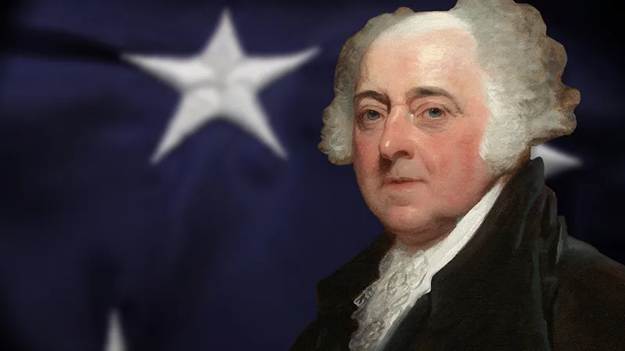
Adams argued that only virtue, ethics, and religion could
sustain a free republic, as without them, the Constitution could NOT prevent
tyranny. It will not ensure freedom and prosperity unless it is supported
by a moral, virtuous population.
……………………………………………………………………………………………………………………………………………
Wishing you good
health, success, and good luck. Till next time.
The Curmudgeon
ajwdct@gmail.com
Follow the Curmudgeon on Twitter @ajwdct247
Curmudgeon is a retired investment professional. He has been involved in financial markets since 1968 (yes, he cut his teeth on the 1968-1974 bear market), became an SEC Registered Investment Advisor in 1995, and received the Chartered Financial Analyst designation from AIMR (now CFA Institute) in 1996. He managed hedged equity and alternative (non-correlated) investment accounts for clients from 1992-2005.
Victor Sperandeo is a historian, economist and financial innovator who has re-invented himself and the companies he's owned (since 1971) to profit in the ever-changing and arcane world of markets, economies, and government policies. Victor started his Wall Street career in 1966 and began trading for a living in 1968. As President and CEO of Alpha Financial Technologies LLC, Sperandeo oversees the firm's research and development platform, which is used to create innovative solutions for different futures markets, risk parameters and other factors.
Copyright © 2026 by the Curmudgeon and Marc Sexton. All rights reserved.
Readers are PROHIBITED from duplicating, copying, or reproducing article(s) written by The Curmudgeon and Victor Sperandeo without providing the URL of the original posted article(s).