Kevin
Warsh’s Influence and Impact on the U.S. Economy and Markets
By Victor Sperandeo with the
Curmudgeon
Introduction:
President
Trump’s nomination of Kevin Warsh as the next Federal Reserve
Chairman took markets by surprise on Friday. Betting platforms previously
expected BlackRock’s Rick Rieder—a prominent globalist figure—to secure the
nomination. However, late on Thursday January 29th, Warsh's probability of
being named the next Fed chair surged to over 85%–94% on Kalshi following reports of his meeting with
Trump at the White House.
Earlier
in the week, the Fed held its policy rate unchanged as expected, though two
FOMC members dissented in favor of a 25-bps rate cut. The CME
Fed Watch tool suggests no rate cut at the March 18th FOMC
meeting with an 87.2% probably of the Fed Funds target rate remaining at 3.5%
to 3.75%.
Markets
React:
The
Warsh nomination announcement triggered a sharp and immediate crack in the
precious metals complex, which experienced one of the largest single-day
price declines in history. April silver futures opened down $80,000 and
ultimately closed Friday’s session at a loss of -$180,190, or -31.4%, while
April gold futures fell -11.4% on the day -its largest single day
percentage loss since January 1980.
The
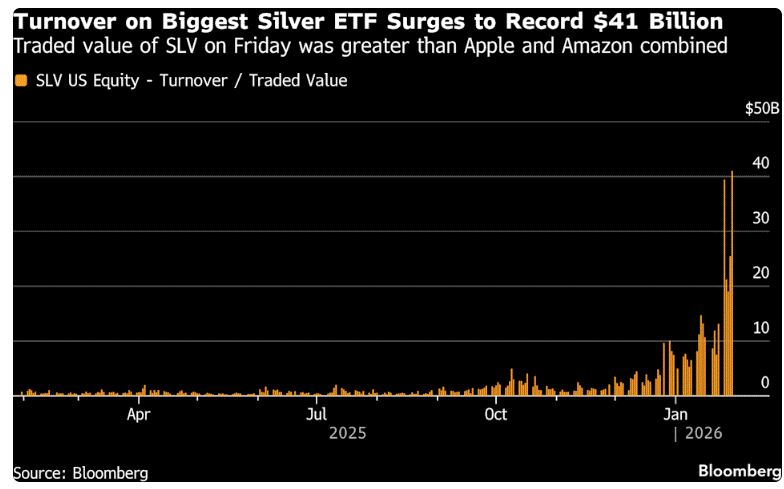
SLV (Silver ETF) trading volume is off the charts, more than doubling
the previous record peak weekly volume from the silver top in 2011. On Friday, SLV traded $41 billion while just
a few months ago, it would rarely see more than $2 billion traded in any given
day.
Bloomberg
reported that precious metal price gains had taken on a very frenzied pace
in recent weeks, driven by a wave of buying from Chinese speculators —
from individual investors to large equity funds venturing into commodities —
that has lifted metals from copper to silver to fresh records. As prices
surged, trend-following commodity trading advisors piled in, adding more froth
to the rally.
“We
had identified about three or four weeks ago that it turned into a momentum
trade, not a fundamental trade,” said Jay Hatfield, chief investment officer at
hedge fund Infrastructure Capital Advisors. “We were just riding it, waiting
for this type of thing to happen.”
As
metals’ upwards momentum drew more and more buyers,
gold and silver fever gripped speculators from China to Germany. It was reminiscent of the period from January
1979-to- January 1980, the only other time in modern history that the
metals markets had such dramatic price swings
U.S.
Treasury yields moved higher while the U.S. dollar
strengthened (DXY ~+1%) on Friday, as markets priced in a more hawkish Fed
stance compared with a deeply dovish Fed chairman like Rick Rieder who has
called for more rate cuts.
Kevin
Warsh Backgrounder:
Mr.
Warsh previously served as a Federal Reserve Governor from 2006 to 2011,
resigning voluntarily in protest over the continuation of the Fed’s second
round of quantitative easing (QE 2). He is a respected figure in global central
banking circles, having earned commendation from former Bank of England
Governor Mark Carney. A disciple of the monetarist school, Warsh studied under
Milton Friedman and aligns with Austrian School principles,
emphasizing that inflation is a policy choice — a view echoing Ludwig von
Mises’ framework of free market economics.
Warsh
has been a consistent critic of post financial crisis quantitative easing,
arguing that QE distorted asset prices, exacerbated inequality, and delivered
poor real economy bang for the buck.
He
is viewed as more tolerant of short-term market volatility and less willing to
use the Fed’s balance sheet as a standing backstop, implying a reaction
function that leans against prolonged negative real rates and “asset-price
targeting.”
WSJ
Editorial on Fed Independence:
Here’s
an excerpt from his April 28, 2025 WSJ Op Ed, The
High Cost of the Fed’s Mission Creep:
Central-bank independence is more
often cited than defined. Independence isn’t a policy goal unto itself. It’s a
means of achieving important and particular policy
outcomes.
Independence is reflexively declared when any Fed policy
is criticized. Congress has granted important functions to the Fed in bank
regulation and supervision. I don’t believe the Fed is owed any particular deference in bank regulatory and supervisory
policy. Fed claims of independence in bank matters undermine the case for
independence in monetary policy.
I strongly believe in the operational independence of
monetary policy as a wise political economy decision. And I believe that Fed
independence is chiefly up to the Fed. That doesn’t
mean central bankers should be treated as pampered princes. When monetary
outcomes are poor, the Fed should be subjected to serious questioning, strong
oversight and, when they err, opprobrium.
Warsh’s
Agenda if Confirmed as Fed Chair:
In
policy communication, Warsh intends to discourage the practice of Fed officials
using “moral suasion” to negatively influence bond yields and will overhaul
outdated Keynesian forecasting models that omit direct monetary variables.
Notably, recent Fed minutes have rarely even referenced “money supply”
as an explicit analytical term—a gap Warsh aims to correct.
If
approved by the Senate, Warsh is expected to cut the Fed Funds rate while
simultaneously engineering a material reduction in the Federal Reserve’s
balance sheet. In this framework, interest rates have only a marginal influence
on inflation [1.], whereas balance-sheet contraction—by shrinking the
money supply and constraining credit creation—delivers the dominant
dis-inflationary impulse.
Note
1. Victor attributes
approximately 5% of price increases (inflation) to the level of interest rates
and 95% to changes in the money supply.
He
suggests that banks could purchase U.S. Treasury securities with newly created
fiat money, while sterilizing those purchases by classifying the securities as
“hold-to-maturity” (HTM). In that structure, banks would not have to deal with
mark-to-market volatility. Also, there would be no incremental reserve
requirement, and banks could then effectively earn an arbitrage spread on a
government loan funded by newly created money.
Victor
suggests that U.S. Treasury Bills need not be placed in HTM accounts because
their prices do not decline meaningfully with rate moves, but longer-dated
securities can be attractive for this purpose since unrealized losses are not
recognized when yields rise. Because HTM assets cannot be sold and thus are not
eligible collateral for repurchase transactions, banks cannot lever them
further, limiting systemic leverage even as they retain the income stream.
Fed’s
Dual Mandate & Reining in U.S. Government Spending:
Warsh
has stated that the Fed will confine itself to its dual mandate of price
stability and full employment, steering clear of
political initiatives such as climate policy. Importantly, Warsh is expected to
warn Congress about the dangers of out of control
federal government spending if he becomes the next Fed Chairman.
Since
February 2020, federal expenditures have risen at a 7.49% compound annual rate,
pushing U.S. debt growth to 8.79%—above the 55.5-year historical average of
8.59%. Should that rate persist, outstanding federal debt could reach $87.8
trillion within a decade, with interest payments alone exceeding $3.5 trillion
annually at a 4% average yield—an unsustainable trajectory that risks eventual
hyperinflation.
While
it’s unclear whether Fed Chairman-designate Warsh can persuade Congress to rein
in fiscal deficits, his willingness to confront the issue marks a distinct
shift from his predecessor, Jerome Powell, who refrained from public commentary
on government spending.
Market
Implications:
If
Warsh is confirmed—a process that could face delay given North Carolina Senator
Thom Tillis’ stated opposition pending resolution of the DoJ’s
probe into Powell—the precious metals complex likely saw its cyclical peak
last week.
Victor
believes that if he is confirmed, Warsh will lower money supply growth
and that's the big risk for precious metal investors and bitcoin holders.
He
expects Bitcoin will now decline SUBSTANTIALLY and remain in a bear
market. with $20,000 as a possibility and likely price target for the world’s
most popular cryptocurrency.
Most
bank and analysts 10-year U.S. Treasury yield forecasts assume only a
modestly more restrictive, higher- for-longer Fed under Warsh with the 10-year
rate around 4–to-4.5% in 2026. RBC Wealth Management: projects the 10-year
yield to end 2026 at about 4.55%. Victor
believes intermediate and long-term interest rates will drift lower (prices
higher) by year's end.
Equity
market multiples, particularly on the S&P 500 and NASDAQ 100,
are expected to compress and stock prices to decline as markets adjust to a monetarist-led Fed.
That’s assuming Warsh is confirmed by the Senate as the next Fed Chair.
If so, he would take office on May 15th when Jerome Powell’s term
ends.
Closing
Quotes:
1. “Parabolic,”
“frenzied” and “untradeable,” were all
descriptions of the silver market on Friday, wrote Nicky Shiels, head of metals
strategy at MKS PAMP SA. She said January 2026 would go down as “the most
volatile month in precious metals history.”
2. Thomas
Jefferson was deeply suspicious of centralized
banking, viewing it as a threat to liberty, a source of corruption, and a tool
that favored speculators over farmers. He warned that banks could create
dangerous levels of debt and favored restricting their
power. Here is one of his quotes for readers to think about.
"If the American people ever allow private banks to
control the issue of their currency, first by inflation, then by deflation, the
banks and corporations that will grow up around them will deprive the people of
all property until their children wake up homeless on the continent their Fathers conquered.... I believe that banking institutions
are more dangerous to our liberties than standing armies.... The issuing power
should be taken from the banks and restored to the people, to whom it properly
belongs."
-->How
correct can a soothsayer be! This is the
gold standard.
………………………………………………………………………………
Wishing you good
health, success, and good luck. Till next time………………………………………………………………………….
The Curmudgeon
ajwdct@gmail.com
Follow the Curmudgeon on Twitter @ajwdct247
Curmudgeon is a retired investment professional. He has been involved in financial markets since 1968 (yes, he cut his teeth on the 1968-1974 bear market), became an SEC Registered Investment Advisor in 1995, and received the Chartered Financial Analyst designation from AIMR (now CFA Institute) in 1996. He managed hedged equity and alternative (non-correlated) investment accounts for clients from 1992-2005.
Victor Sperandeo is a historian, economist and financial innovator who has re-invented himself and the companies he's owned (since 1971) to profit in the ever-changing and arcane world of markets, economies, and government policies. Victor started his Wall Street career in 1966 and began trading for a living in 1968. As President and CEO of Alpha Financial Technologies LLC, Sperandeo oversees the firm's research and development platform, which is used to create innovative solutions for different futures markets, risk parameters and other factors.
Copyright © 2025 by the Curmudgeon and Marc Sexton. All rights reserved.
Readers are PROHIBITED from duplicating, copying, or reproducing article(s) written by The Curmudgeon and Victor Sperandeo without providing the URL of the original posted article(s).