What’s
Really Driving the Surge in Gold and Silver
By Victor Sperandeo with the
Curmudgeon
Introduction:
On
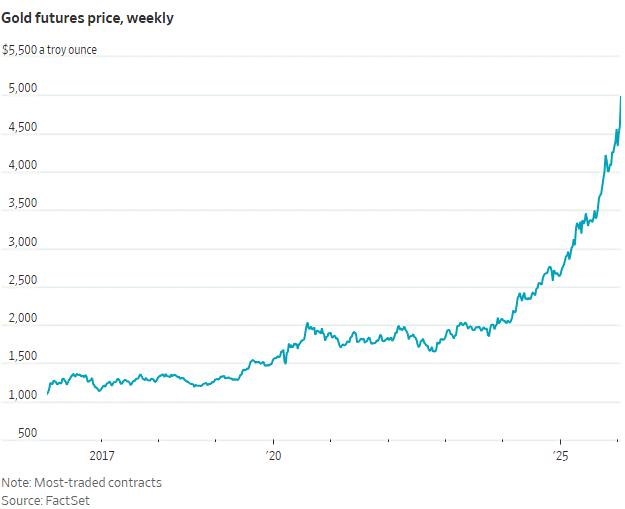
Friday, Gold (March COMEX futures) closed at $5,001.10 while Silver (March
COMEX futures) settled at $103.26 — a remarkable level that demands analysis of
both the drivers and implications behind this surge in the precious metals.
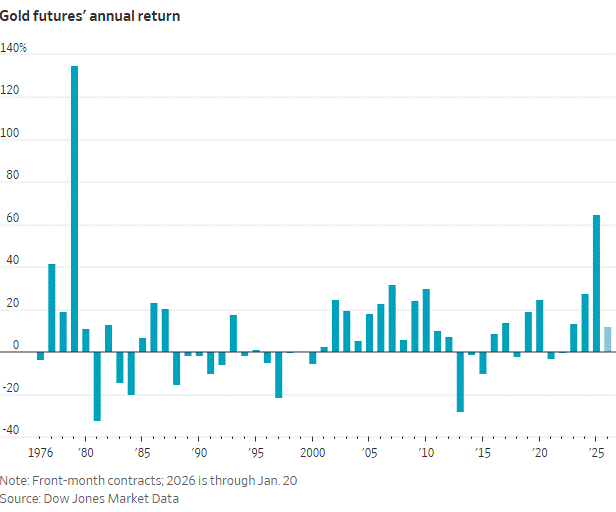
Gold and Silver are in one of the most powerful and sustained bull markets in
their history, with no meaningful correction since September 2023.
The
most recent upside momentum was sparked by rhetoric and statements from global
leaders at the World Economic Forum (WEF) in Davos, intensifying already
positive investor sentiment toward hard assets. Much more below.
Full
Disclosure: Victor is a long-term investor in both
gold and silver. However, he and the Curmudgeon caution others
against relying on overly promotional commentary from bullion dealers or online
gold advocates. Such sources often offer one-sided bullish forecasts without
addressing risk or valuation discipline — no different from stock-promotion
chatter on financial media or speculative hype from cryptocurrency promoters.
Please ignore those perma-bull clarion calls.
Impressive
Charts:
…………………………………………………………………………….
Market
Assessment:
In
the near term, equities and precious metals markets appear overextended. A
correction in both seems plausible this quarter, driven by economic softness
and potential monetary policy re-calibration by the Federal Reserve which is
not expected to lower the Federal Funds rate at next week’s FOMC meeting.
While
price momentum is strong, I believe the current precious metals rally is not
fundamentally economic in nature, but primarily political. Global governments
continue to expand their balance sheets through money creation — not purely for
growth or stabilization, but often to preserve political power. Programs framed
as “modest” inflation targeting or stimulus serve a dual purpose: 1.]
sustaining short-term economic activity and 2.] gradually eroding public
savings through inflation to reduce real debt burdens.
The
confiscation of over $300 billion in Russian reserves following U.S. sanctions
was a profound geopolitical signal — a warning to other nations that sovereign
assets, when held in Western institutions, are no longer safe from political
intervention. Also, the U.S intervention in Venezuela has tested the dollar’s
“safe haven” status.
These
events fundamentally undermined confidence in dollar-denominated reserves and
accelerated the diversification away from U.S. Treasuries. The consequence has
been an ongoing monetary realignment, with countries and private investors
seeking assets beyond the reach of centralized power — assets such as gold,
which serves not only as an inflation hedge but also
as a store of value in times of political instability.
Central
Bank Buying of Gold:
Historically,
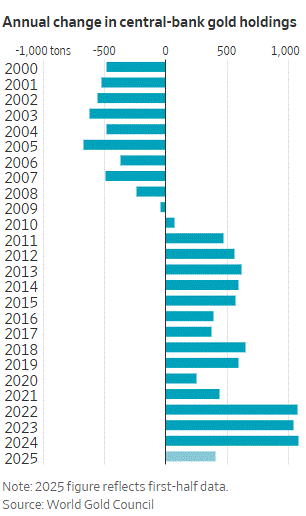
net sellers of bullion, central banks transitioned to persistent net buyers of
gold in 2010 as the Global Financial Crisis necessitated a strategic
re-evaluation of systemic risk. This trend accelerated sharply in 2022
following Russia’s invasion of Ukraine and the subsequent sanctions against
Russia. Emerging market central banks and the Peoples Bank of China are
aggressively diversifying away from U.S. dollar denominated assets into hard
assets like gold and real estate to mitigate geopolitical and seizure risks.
Concurrently, institutions like the National Bank of Poland are leveraging
gold's role as a Tier-1 reserve asset to bolster currency stability and offset
the credit risks inherent in sovereign debt holdings.
As
of late 2024 and into 2025, gold makes up roughly 20% of total global central
bank reserves, a significant increase from prior years, surpassing the euro to
become the world's second-largest reserve asset after the U.S. dollar, driven
by geopolitical uncertainty and diversification away from fiat currencies. This
share is up from about 10% in the 2010s, with emerging economies leading the
trend.
2026
WEF Take Aways:
At the 2026 WEF Conference, remarks by Mark Carney, former Bank of
England Governor and now Prime Minister of Canada, further shook perceptions of
the so-called “rules-based international order.” His acknowledgment that this
framework was “partially false” confirmed what many already suspected -- that much
of the postwar economic narrative has served political and institutional
self-preservation. This revelation, amplified by independent commentators,
underscores a growing realization that economic governance increasingly
prioritizes control and continuity over transparency and truth to enable world
leaders to retain power.
A
quote from the evil Nazi politician Joseph Goebbels comes to mind here:
“If
you tell a lie big enough and keep repeating it, people will eventually come to
believe it.”
Sadly,
this is now the premise of all government’s slogans based on what they want the
common person to believe. It is a playbook to dominate and control the people,
which makes them into “serfs.”
Notably,
the WEF’s virtual abandonment of “Global Warming” language in its agenda
signals a strategic pivot among political and financial elites. The narrative
emphasis is shifting — possibly toward economic control mechanisms and digital
governance — suggesting that the true “big lie” Carney referenced may relate
less to environmental policy itself, and more to how global governance
redefines the balance of financial power under emergent systems.
Conclusions:
Victor
suspects the WEF examples cited above will act as axioms FOR ALL GOVERNMENT
EDICTS including its AGENCIES (e.g. the Fed), that try to enslave and control
people with made-up agendas. That makes
them not only liars, but the enemies of liberty!
The
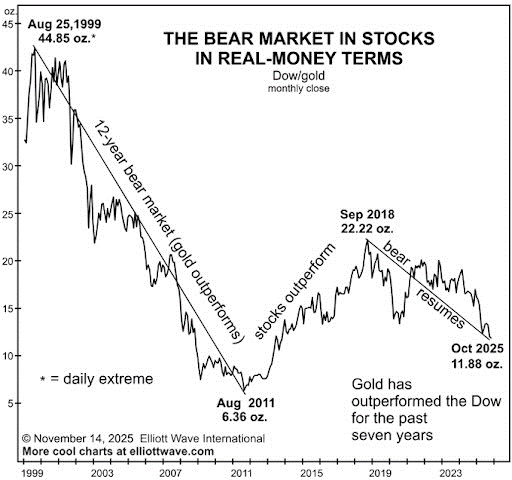
Curmudgeon calls attention to January’s Elliott Wave Theorist, where
Robert Prechter notes that while the Dow Jones Industrial average (DJI) made a
new all-time high in December 2025, it concurrently made a 12-year low in real
money terms (e.g. gold). The chart below
depicts the DJI/Gold ratio from 1999 and its 7-year bear market. Incredibly, the DJI/Gold ratio has fallen by
half since Sept 2018 while the nominal DJI has doubled over the same period.
…………………………………………………………………………………….
End
Quote:
Elton
John is one of the greatest singer-song writers of all time. With lyrics
written by song writing team partner Bernie Taupin, the song is about liberty
of wild Mustang horses. It’s titled, “Live
Like Horses.” Here’s the ending:
“Someday,
we'll live like horses. Free reign from your old iron fences. There's more ways than one to regain your senses. Break out
the stalls and we'll live like horses Someday.”
………………………………………………………………………………
Wishing you good
health, success, and good luck. Till next time………………………………………………………………………….
The Curmudgeon
ajwdct@gmail.com
Follow the Curmudgeon on Twitter @ajwdct247
Curmudgeon is a retired investment professional. He has been involved in financial markets since 1968 (yes, he cut his teeth on the 1968-1974 bear market), became an SEC Registered Investment Advisor in 1995, and received the Chartered Financial Analyst designation from AIMR (now CFA Institute) in 1996. He managed hedged equity and alternative (non-correlated) investment accounts for clients from 1992-2005.
Victor Sperandeo is a historian, economist and financial innovator who has re-invented himself and the companies he's owned (since 1971) to profit in the ever-changing and arcane world of markets, economies, and government policies. Victor started his Wall Street career in 1966 and began trading for a living in 1968. As President and CEO of Alpha Financial Technologies LLC, Sperandeo oversees the firm's research and development platform, which is used to create innovative solutions for different futures markets, risk parameters and other factors.
Copyright © 2025 by the Curmudgeon and Marc Sexton. All rights reserved.
Readers are PROHIBITED from duplicating, copying, or reproducing article(s) written by The Curmudgeon and Victor Sperandeo without providing the URL of the original posted article(s).