Fed’s
Hawkish Rate Cut & Deception; LEI Decline Continues
By the Curmudgeon with Victor
Sperandeo
Fed Cuts Rates Amongst Overt and Silent Dissenters:
As widely expected, the Fed
cut its benchmark interest rate this week by 25-bps to a range between 3.5% and
3.75%, a three-year low. However, the decision drew three dissenting votes, the
most since 2019.
·
Austan Goolsbee, President of
the Chicago Fed, and Jeffrey Schmid, President of the Kansas City Fed both
opposed any rate Fed Funds rate reduction citing concerns about lingering
inflation risks.
·
Fed governor and former Trump
adviser Stephen Miran, voted for a larger half-point cut, which is consistent
to what his former boss deeply desires.
Asked on Friday where he wants interest rates to be a year
from now, Trump said, “1% and maybe lower than that.” He said rate cuts would
help the U.S. Treasury reduce the costs of financing $30 trillion in government
debt. “We should have the lowest rate in the world,” Trump added.
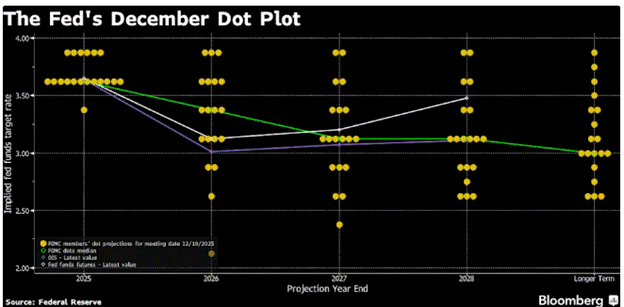
Double talk? In quarterly Fed Funds rate projections, the Fed published
on Wednesday, six policymakers said the benchmark Federal Funds rate should end
2025 in a range of 3.75% to 4% — exactly where it was before Wednesday’s 25-bps rate
cut — suggesting they opposed the move.
Given that at least four and perhaps all of
those six officials lacked a vote at the meeting, some Fed watchers have dubbed
the end of 2025 rate forecasts as “silent dissents.”
Many pundits believe
that several FOMC voting members didn’t want to cut rates this week but
relented and went along with it so as not to anger Trump.
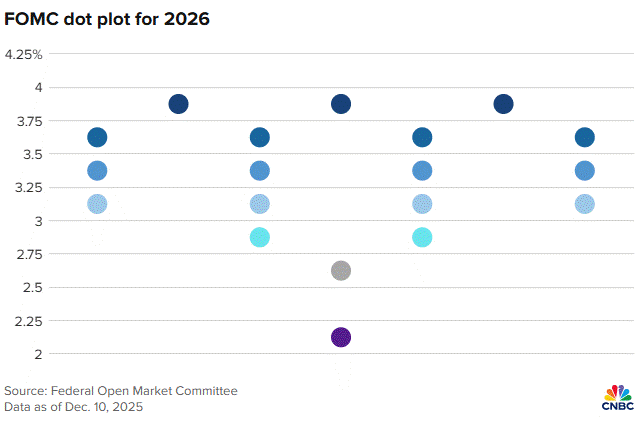
The Fed’s “dot plot” for 2026, also released this week,
indicates a median estimate of 3.4% for the Federal Funds rate at the end of
2026, a quarter point lower than the current range between 3.5%-3.75%. Note
that only 12 of the 19 Fed officials have a vote at FOMC meetings.
Here
are the Fed’s latest Fed Funds rate targets from 19 FOMC members, both voters
and nonvoters:
……………………………………………………………………………………
Fed Begins a
T-Bill Buying Binge:
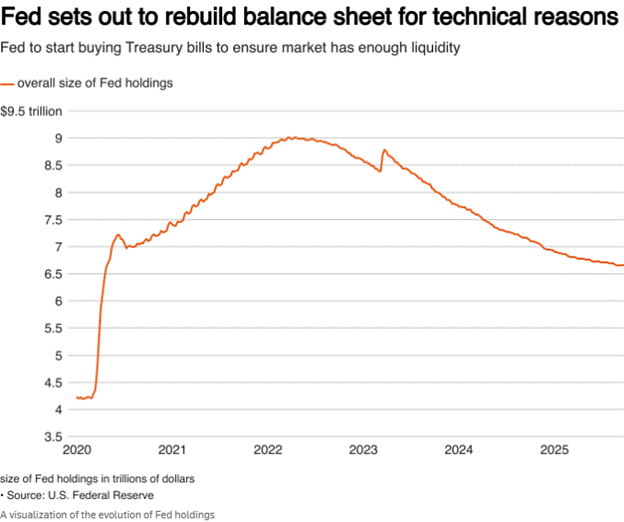
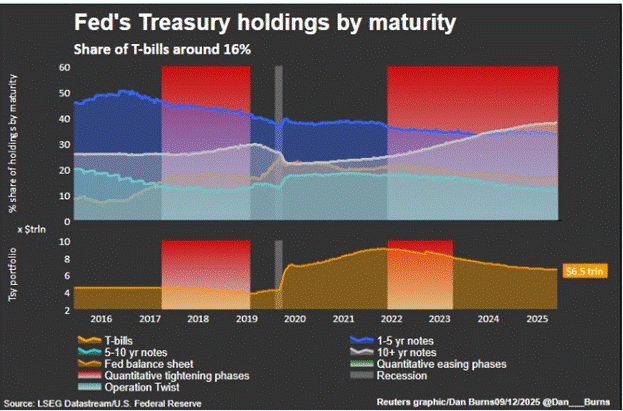
Astonishingly, after ending its Quantitative Tightening (QT)
program on December 1, 2025, the Fed announced that it would
be buying $40 billion of Treasury bills a month. Starting Friday, December
12th. The Fed said in a statement that its buying "will remain
elevated for a few months to offset expected large increases in non-reserve
liabilities in April," adding, "after that, the pace of total
purchases will likely be significantly reduced in line with expected seasonal
patterns in Federal Reserve liabilities."
In particular, Fed Chair Jerome Powell said these Reserve Management Purchases (RMPs) were made to prevent a
tightening of short-term liquidity ahead of the April 15th tax
payments. The U.S. central bank claims
that’s ordinary management of money-market conditions.
Does anyone really
believe that?
The Curmudgeon and several analysts view this T-bill buying
binge as clandestine coordination with the U.S. Treasury department. The aim is
to help fund the massive U.S. budget deficit and lower the supply of longer term U.S. debt to be auctioned in the coming months.
George Goncalves, head of U.S. macro strategy at MUFG Securities America, says he doesn’t know why the Fed would see
the need to preempt tax-season pressures so far in advance (April 15th
is four months away). He says the Fed has other ways to cope with temporary
money market disruptions, such as the Standing
Repurchase Agreement facility, which it didn’t have in 2019 when the repo
market suffered temporary shocks from liquidity shortages.
Goncalves notes the Fed will be buying more like $60 billion of T-bills a month, which includes the
reinvestment of monthly pay downs from its $2 trillion of agency
mortgage-backed securities holdings. Moreover, it could augment its bill
purchases by also buying short-term T-notes, he says. That would absorb a lot
of paper from the markets.
Strategas’ policy team, led by Daniel Clifton, estimates the Fed’s
annual demand for $240 billion to $300 billion of T-bills would take up between
60% and 75% of the Treasury’s issuance of these short-term obligations.
The RMPs don’t constitute quantitative easing, or QE, as
central bank buying is formally called, the Fed says. Yet the Strategas team wrote that the Fed’s
T-bill purchases still have an impact, by allowing the Treasury’s debt managers
to boost T-bills’ share to 30% of total borrowings from 22%. In turn, auctions
of T-notes and T-bonds would be smaller. In addition, the Treasury repurchases
less actively traded (“off the run”) notes and bonds with the stated aim of
improving market liquidity. Those repurchases have been stepped up, to $150
billion annually.
TS Lombard’s chief U.S. economist, Steven Blitz, calls the renewed Fed
purchases an effective merging of the
U.S. central bank with the Treasury, and a further step in the undoing of
the 1951 Accord between the two to
separate monetary policy from government debt management. This “fiscal
dominance” of Fed policy will ultimately prove to be inflationary, he
concludes.
Bank of America global rate strategists dubbed the Fed’s T-bill buying as “financial RMP-pression” (think
“interest rate repression”) in a client note on Friday. While the Fed insists
the purchases aren’t quantitative easing, “RMPs are to QE what beer is to
drinking,” writes Randall Forsyth in Barron’s (paywall).
àRegarding the Fed’s latest deception, we once again
ask, “who’s kidding whom?”
Victor’s
Comments:
My views are IDENTICAL to the quote
by Louis T. McFadden in last week’s post. For additional clarity:
The Fed and many other U.S. government agencies are pure evil and 100% against
the interests of American citizens.
Apparently, their goal is to change the U.S. Constitution and its
liberties. Sadly, I have nothing positive to say this week.
LEI
Continues its Decline:
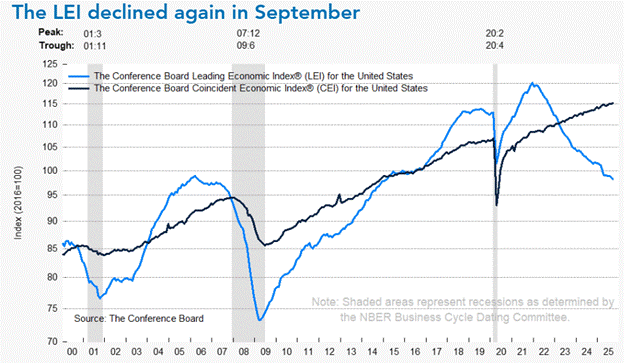
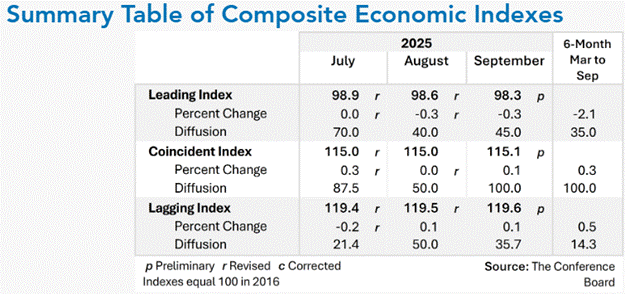
The Leading Economic Index (LEI) from the Conference Board
was released for September following a long delay due to the U.S. government
shutdown. The index fell -0.3% as expectations from both consumers and
businesses weakened. This indicates that economic growth is likely to slow
through the end of the year and into early 2026.
“The US LEI fell again in September, marking a 2nd
consecutive decline,” said Justyna Zabinska-La Monica, Senior Manager, Business
Cycle Indicators, at The Conference Board.
“Weakening expectations
from consumers and businesses led the overall contraction in the Index. Sub indexes that contributed negatively to the LEI were
consumer expectations and ISM® New Orders Index, followed by manufacturers' new
orders of consumer goods & materials, initial claims for unemployment
Insurance (inverted), and the yield curve. However, stock prices, the Leading
Credit Index, and manufacturers' new orders of nondefense
capital goods excl. aircraft did contribute positively to the Index. The LEI
suggests slowing economic activity at the end of 2025 and into early 2026, with
GDP weakening after strong mid-year consumer spending and Q4 disruptions amid
the federal government shutdown. Overall, growth remains fragile and uneven as
businesses adjust to tariff changes and softer consumer momentum. The
Conference Board expects GDP to expand by 1.8% in 2025, before falling to 1.5%
in 2026.”
……………………………………………………………………………………………….
Conclusions
and End Quote:
Michael Burry of “Big Short” fame said the
Fed's plan to begin "reserve management purchases" — or RMPs —
signals growing fragility in the U.S.
banking system. He pointed to the central bank's decision to stop shrinking
its balance sheet and prepare to buy roughly $35 billion to $45 billion in
Treasury bills each month, a move analysts expect to begin in January.
"I would add that if the U.S. banking system can't
function without $3+ trillion in reserves/life support from the Fed, that is
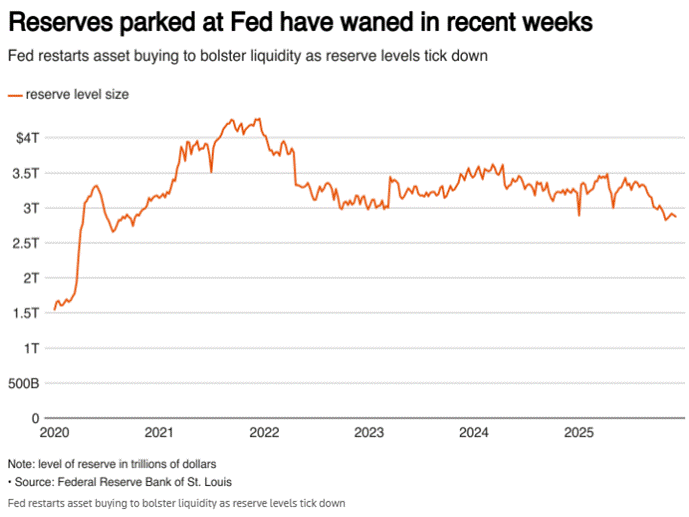
not a sign of strength but a sign of fragility," he said. The U.S. financial system required only about
$2.2 trillion before the 2023 banking turmoil and just $45 billion in 2007,
Burry added.
………………………………………………………………………………………………….
Wishing you good health, success and
peace of mind. Till next time……
The Curmudgeon
ajwdct@gmail.com
Follow the Curmudgeon on Twitter @ajwdct247
Curmudgeon is a retired investment professional. He has been involved in financial markets since 1968 (yes, he cut his teeth on the 1968-1974 bear market), became an SEC Registered Investment Advisor in 1995, and received the Chartered Financial Analyst designation from AIMR (now CFA Institute) in 1996. He managed hedged equity and alternative (non-correlated) investment accounts for clients from 1992-2005.
Victor Sperandeo is a historian, economist and financial innovator who has re-invented himself and the companies he's owned (since 1971) to profit in the ever-changing and arcane world of markets, economies, and government policies. Victor started his Wall Street career in 1966 and began trading for a living in 1968. As President and CEO of Alpha Financial Technologies LLC, Sperandeo oversees the firm's research and development platform, which is used to create innovative solutions for different futures markets, risk parameters and other factors.
Copyright © 2025 by the Curmudgeon and Marc Sexton. All rights reserved.
Readers are PROHIBITED from duplicating, copying, or reproducing article(s) written by The Curmudgeon and Victor Sperandeo without providing the URL of the original posted article(s).