Fed
Meeting Preview, U.S. Bond Market Selloff, Impact of Trump's Tariffs
By Victor Sperandeo with the
Curmudgeon
Our Purpose:
Curmudgeon/Sperandeo posts are intended to help readers understand WHY markets
move the way they do. In so doing, we
identify underlying issues (largely ignored by the mainstream media) that might
temper “irrational exuberance” and help control risk. We try to provide valuable, experience-based
insights and analysis on market trends, economic conditions, and government
policies. Readers get access to a
consistent, well-researched professional perspective that helps them navigate
the complexities and "arcane world" of markets, economics and
politics.
PCE Index Comes in as
Expected:
The Personal Consumption
Expenditures (PCE) price Index reading for September came out this week in
a delayed release due to the government shutdown.
l The Overall reading
increased +0.3% for the month and increased from 2.7% to 2.8% year-over-year.
l The Core reading, which excludes the
volatile food and energy components, was +0.2% for the month, but decreased
from 2.9% to 2.8% year-over-year, which was in line with analyst estimates.
While this report is three months
old, it is the latest data the Fed has from their preferred measure of
inflation going into their meeting next week, making it crucial in determining
if there will be a rate cut this month.
Fed Meeting Preview:
Policy, Politics, and Market Narratives:
The Federal Reserve’s interest
rate policy-setting committee (FOMC) convenes this week with financial markets
largely expecting a 25-basis-point reduction in the Federal Funds target
range—from 3.75%–4.00% to 3.50%–3.75%. The CME
Fed Watch Tool assigns an 86.2% probability of such a 25-bps
rate cut.
The consensus reflects both softer
economic data and Fed officials’ recent communications, which have suggested a
willingness to ease financial conditions amid slowing momentum in employment
and inflation indicators. That’s despite
the Core PCE - the Fed’s preferred inflation gauge- is at 2.8%
year-over-year, which is above the Fed’s 2% inflation target. Evidently, the
Fed is much more focused on the jobs market than inflation at
this time.
While FOMC decisions are often
interpreted as the direct catalyst for interest-rate movements, the underlying
macroeconomic backdrop—growth, inflation, and liquidity conditions—remains the
dominant force shaping yields. However,
Fed officials (too) often influence expectations through forward guidance,
which acts as a powerful mechanism for steering markets. Their rhetoric and
framing of economic risks can move yields as much as policy actions themselves.
Lessons from the UK - When
Markets Challenge Monetary Policy Direction:
Recent bond market volatility has
reminded investors of the 2022 episode surrounding former UK Prime Minister
Liz Truss. Her administration’s proposed tax cuts clashed with the Bank of
England’s priorities, triggering a sharp sell-off in UK gilts and ultimately
contributing to her abrupt resignation in what became the shortest premiership
in British history. The episode reinforced a broader lesson: markets react
swiftly when fiscal intentions and monetary priorities diverge.
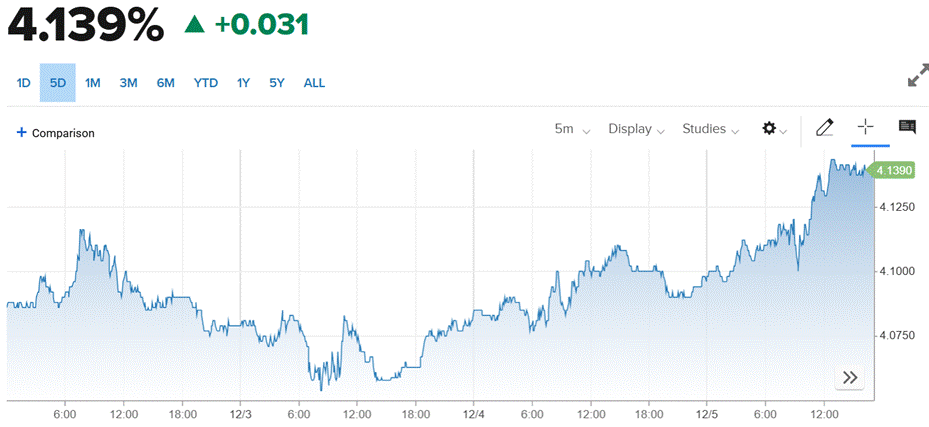
Last week’s U.S. Treasury market
movement showed a similar dynamic. Despite softer labor-market data and a benign
core PCE inflation reading—conditions that would normally support lower
yields—intermediate and long-term Treasuries sold off. The move was attributed
to speculation surrounding potential future Federal Reserve leadership. Here’s a 5-day chart of the yield on the 10-year
U.S. Treasury Note:
Investors grew concerned that a
Fed chaired by Kevin Hassett, current Director of the National Economic Council,
might prioritize aggressive rate cuts to stimulate economic growth, which is
what U.S. President Donald Trump has been relentlessly pushing for months.
Fixed income markets last week
perceived such future Fed rate cuts as raising the risk of higher future
inflation and undermining the independence of the Fed.
Although highly speculative, this
narrative was enough to shift market pricing, illustrating once again how
political considerations can become entwined with monetary-policy expectations.
Interest Rates, Liquidity,
and a Historical Perspective:
A central misconception in public
policy debates is the extent to which nominal interest rates alone determine
inflation. Historical evidence suggests a more nuanced relationship in which
liquidity and money-supply dynamics are the primary drivers.
During the Great Depression,
consumer prices fell sharply from 1929 to 1932 even as short-term Treasury
yields declined. To illustrate that interest rates alone do not drive
inflation, note the strong deflation of 1929–1932 despite collapsing short-term
rates.
Year CPI % Change 3-Month T-Bill
Yield (%)
1929 +0.58% 4.75%
1930 –6.40% 2.41%
1931 –9.32% 1.07%
1932 –10.27% 0.96%
At the same time, the money supply
contracted roughly one-third, a point extensively documented by Milton Friedman
and Allan H. Meltzer. As Friedman famously noted:
“The money stock, which stood at
$28.264 billion in October 1929, fell to $19.039 billion by April 1933—a
decline of almost 33%. Economic activity followed.”
This historical backdrop
underscores that liquidity conditions—not merely nominal rate levels—play a
central role in shaping economic outcomes. It is also notable that modern
Federal Reserve models place limited emphasis on money-supply measures, a methodological
choice that continues to draw criticism from monetarist
economists as well as authors of this post.
Policy, Politics, and
Market Interpretation:
Whether Kevin Hassett ultimately
leads the Federal Reserve has not been confirmed by Trump and he would have to
be approved by the Senate. Also, the
next Fed Chair will take the helm more than five months from now - on May 15,
2026, when Jerome Powell’s term ends. No
one knows what economic conditions will be like at that time?
Nonetheless, the episode illustrates how narratives—accurate or otherwise—can
drive short-term bond market behavior.
Markets often react not only to data,
but also to politically charged speculation about future policy direction. When
those narratives are founded on incomplete or
incorrect assumptions, the resulting price action may reflect sentiment rather
than fundamentals.
Investment Implications:
Given the current economic
trajectory and expectations for further easing into the mid-term election
cycle, intermediate-term Treasuries—particularly with 2- to- 5-year
maturities—appear positioned to benefit over the next six to nine months.
Slowing economic growth, moderating inflation, and a likely shift toward a more
accommodating Fed policy stance support this view.
What remains most striking is the
degree to which political considerations continue to shape monetary-policy
expectations. Regardless of administration, central-bank independence
remains a key variable in market confidence. Investors will be watching not
only the Fed’s rate decision this week but also how policymakers characterize
the path ahead—a signal that may prove even more influential than the rate move
itself.
Victor’s Market Positioning:
2 to-5-year T-Notes are a buy/hold for the next 6-to-9 months going
into the November 2026 mid-term elections.
Of course, owning Gold as an
investment is a "must" due to current geopolitical risks and out
of control U.S. government spending.
Victor’s Conclusions:
Current Fed Chair Jerome Powell
does not want Trump to succeed. I believe that Trump’s policies will fail on
their own, without the Fed following his demands to significantly lower
rates or talk about forthcoming “easy money.” Trump’s unbreakable conviction on
tariffs, which are a tax on consumers, will cause the U.S. economy to weaken
significantly. That will be enough to kill any success he might otherwise have
had.
Well respected American economist Jeffrey
Sachs has strongly criticized Trump's tariff policies as "stupid,
bizarre," and self-destructive," arguing that they isolate the U.S.,
weaken its global standing, and are illegal under both U.S. and international
law, serving no real economic benefit and damaging key relationships,
especially with India. He sees them as a sign of incompetence, undermining
American leadership and fostering a "crazy land" of protectionism,
urging other nations to resist.
Professor Sachs argues that
Trump's tariff logic is flawed and is "Mickey Mouse economics. It’s like
“someone goes shopping, uses a credit card and runs up a debt, but then blames
the merchant that sold you the goods. Sachs quoted Trump's implied logic as:
"They're ripping me off! ... I'm running a trade deficit!" with the
shops, which he characterizes as an absurd position.
Bottom line:
Trump’s tariffs are equivalent to raising taxes during an economic slowdown,
which is very harmful to consumers. Economists noted that the additional costs
and global market uncertainty could lead to a weaker economy or potential
recession, which is the opposite of the "Liberation Day" Trump
promised in April.
End Quote:
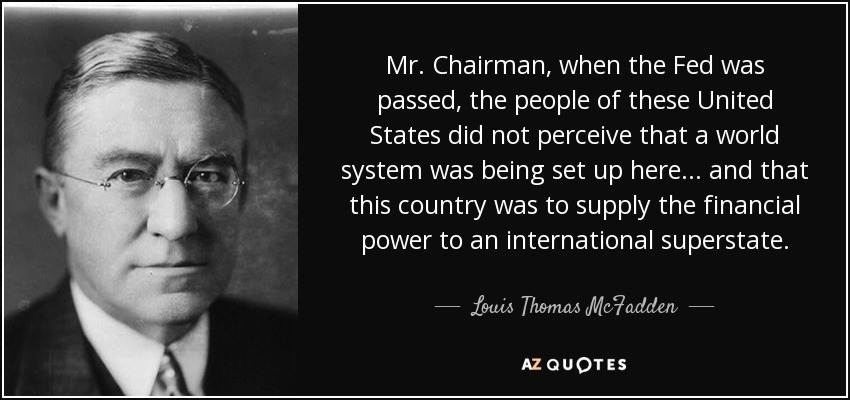
“We have, in this country, one of
the most corrupt institutions the world has ever known. I refer to the Federal
Reserve Board. This evil institution has impoverished the people of the
United States and has practically bankrupted our government. It has done this
through the corrupt practices of the moneyed vultures who control it.”
Louis Thomas McFadden - was a Republican member of the United States
House of Representatives from Pennsylvania, serving from 1915 to 1935. He was
chairman of the U.S. Banking Committee in 1930.
…………………………………………………………………………………………………………………..
Wishing you good health,
success and peace of mind. Till next time……
The Curmudgeon
ajwdct@gmail.com
Follow the Curmudgeon on Twitter @ajwdct247
Curmudgeon is a retired investment professional. He has been involved in financial markets since 1968 (yes, he cut his teeth on the 1968-1974 bear market), became an SEC Registered Investment Advisor in 1995, and received the Chartered Financial Analyst designation from AIMR (now CFA Institute) in 1996. He managed hedged equity and alternative (non-correlated) investment accounts for clients from 1992-2005.
Victor Sperandeo is a historian, economist and financial innovator who has re-invented himself and the companies he's owned (since 1971) to profit in the ever-changing and arcane world of markets, economies, and government policies. Victor started his Wall Street career in 1966 and began trading for a living in 1968. As President and CEO of Alpha Financial Technologies LLC, Sperandeo oversees the firm's research and development platform, which is used to create innovative solutions for different futures markets, risk parameters and other factors.
Copyright © 2025 by the Curmudgeon and Marc Sexton. All rights reserved.
Readers are PROHIBITED from duplicating, copying, or reproducing article(s) written by The Curmudgeon and Victor Sperandeo without providing the URL of the original posted article(s).